

Dhaka 3:55 pm, Monday, 9 November 2026
Coastal flood damage could multiply, warns report

Climate Change Could Displace 7.5% of Bangladesh’s Population by 2050: ADB

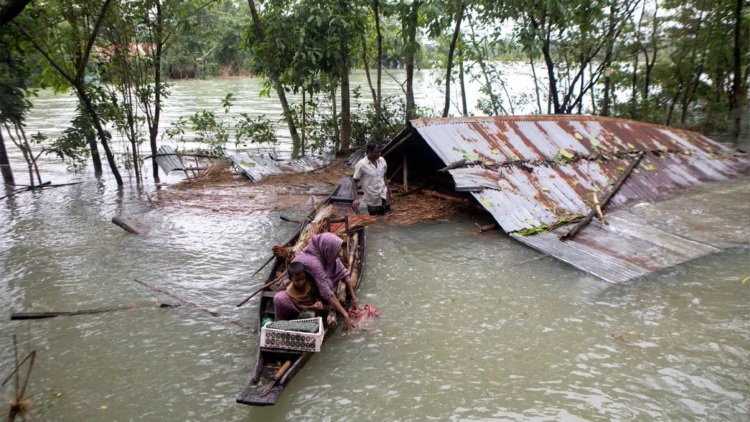
Nearly 7.5 per cent of Bangladesh’s population could be forced to move from one region of the country to another by 2050 due to the adverse impacts of climate change, according to a report by the Asian Development Bank (ADB).

Rising sea levels, coastal flooding, freshwater shortages and declining agricultural productivity are expected to intensify the risks. Climate change is also placing growing pressure on public health, food security, the economy and housing, the report warned.

The findings were presented in ADB’s Asia-Pacific Climate Report 2026: Coastal Risks on the Rise—Actions for a Resilient Future, published on October 21. The report assesses the growing impact of coastal climate risks across the Asia-Pacific region, potential economic losses and measures needed to strengthen resilience.

According to the report, Bangladesh, Myanmar and India face mounting challenges from coastal climate change. A significant proportion of people living in areas at high risk of coastal flooding are poor, leaving them with limited financial resources to prepare for disasters, recover from losses or relocate to safer areas.

Rising Sea Levels and Land Subsidence Increase Risks
Bangladesh’s coastal delta is becoming increasingly vulnerable due to rising global sea levels and local land subsidence. The report states that land subsidence in different parts of the delta ranges from 4 to 55 millimetres annually, increasing the risks of agricultural land loss and coastal flooding.

Under a high-emissions scenario, known as SSP5-8.5, approximately 17.4 million people in Bangladesh could face coastal flooding risks every year by 2100. The annual economic losses from such disasters could reach up to 15 per cent of the country’s gross domestic product (GDP), the report estimates.

Saltwater intrusion in coastal areas is another growing concern. The report notes associations between increasing salinity in groundwater and drinking water sources and health problems, including high blood pressure during pregnancy, cardiovascular diseases and kidney disorders. Persistent shortages of safe drinking water could have long-term consequences for public health.

Women and Poor Communities Face Greater Risks
Women and girls are disproportionately affected by climate change. Food insecurity following disasters, caregiving responsibilities and the burden of unpaid domestic work can make their lives increasingly difficult.

As salinity rises in shallow tube wells and other water sources in coastal areas, many women have to travel longer distances to collect safe drinking water.

The loss of homes, farmland and ancestral property can also seriously affect mental health. Uncertainty about the future, loss of livelihoods and the prospect of leaving their homes can contribute to psychological stress, anxiety and depression.

According to the report, poor coastal communities have limited financial capacity to adapt to climate change, relocate or recover from disaster-related losses. As a result, they are likely to face greater hardship as the risk of climate-induced displacement increases.

Annual Coastal Flood Losses Could Rise 20-Fold
ADB warns that without effective adaptation measures and coastal protection systems, annual coastal flood losses across the Asia-Pacific region could increase more than sixfold by 2050 and nearly 20-fold by 2100.

Annual flood-related losses across 30 coastal economies currently stand at approximately $27 billion. Depending on future climate conditions and development pathways, these losses could rise to between $172 billion and $199 billion by 2050, and between $520 billion and $739 billion by 2100.

The report estimates that annual investments of $9 billion to $19 billion in coastal protection may be required to limit the damage. Properly targeted investments could potentially prevent $178 billion to $360 billion in flood-related losses each year.

Yevgeny Zhukov, director general of ADB’s Climate Change and Sustainable Development Department, said coastal areas are important drivers of economic growth across the Asia-Pacific region. However, rising sea levels and extreme climate-related disasters are making these areas increasingly vulnerable.

He stressed the need for long-term, adaptable and risk-informed solutions to strengthen coastal resilience and protect lives and economic activities.

Bangladesh’s Climate Adaptation Initiatives
The report highlights several long-term initiatives undertaken by Bangladesh to address climate risks. One of the key initiatives is the Bangladesh Delta Plan 2100, adopted in 2018.

The plan outlines an investment framework of approximately $52 billion for 80 priority projects in coastal and riverine areas. It also sets a target of increasing government spending on delta-related activities to 2.5 per cent of GDP.

Bangladesh has constructed approximately 5,000 multipurpose cyclone shelters, many of which serve as primary schools during normal periods.

Improved weather forecasting, early warning systems and community preparedness have helped reduce cyclone-related fatalities by more than 99 per cent compared with historical levels, the report states.

Community participation is also playing an important role in disaster preparedness. Youth-led weather clubs in coastal schools train students to interpret weather forecasts and communicate early warnings to their families.

Long-Term Planning Needed to Address Displacement
ADB says strengthening coastal protection alone will not be sufficient to address potential climate-induced displacement. Long-term planning is also needed in areas where displaced people may settle, particularly to ensure adequate housing, employment opportunities, healthcare, safe drinking water and urban infrastructure.

The report estimates that investments in coastal resilience could generate benefits up to 20 times greater than their costs. It recommends integrating climate adaptation into development planning, strengthening institutions and governance, securing adequate financing and increasing local community participation.

International adaptation finance for coastal developing economies in the Asia-Pacific region increased from approximately $5 billion in 2015 to an annual average of $11.4 billion in 2022–23. However, the report notes that financing remains insufficient compared with the resources required to address growing climate risks.

It also emphasises the importance of public financing, alongside stronger government revenue capacity, greater private-sector investment and expanded access to long-term financing on favourable terms.

Overall, ADB’s assessment highlights that climate change poses challenges for Bangladesh beyond the environment, directly affecting housing, livelihoods, public health, food security and economic stability.

The report underscores the need for a coordinated long-term strategy combining coastal protection, climate-resilient infrastructure, safe water supplies and rehabilitation plans for people who may be forced to relocate.

Coastal flood damage could multiply, warns report

Climate Change Could Displace 7.5% of Bangladesh’s Population by 2050: ADB

Update Time: 08:38:57 pm, Thursday, 22 October 2026

Nearly 7.5 per cent of Bangladesh’s population could be forced to move from one region of the country to another by 2050 due to the adverse impacts of climate change, according to a report by the Asian Development Bank (ADB).

Rising sea levels, coastal flooding, freshwater shortages and declining agricultural productivity are expected to intensify the risks. Climate change is also placing growing pressure on public health, food security, the economy and housing, the report warned.

The findings were presented in ADB’s Asia-Pacific Climate Report 2026: Coastal Risks on the Rise—Actions for a Resilient Future, published on October 21. The report assesses the growing impact of coastal climate risks across the Asia-Pacific region, potential economic losses and measures needed to strengthen resilience.

According to the report, Bangladesh, Myanmar and India face mounting challenges from coastal climate change. A significant proportion of people living in areas at high risk of coastal flooding are poor, leaving them with limited financial resources to prepare for disasters, recover from losses or relocate to safer areas.

Rising Sea Levels and Land Subsidence Increase Risks
Bangladesh’s coastal delta is becoming increasingly vulnerable due to rising global sea levels and local land subsidence. The report states that land subsidence in different parts of the delta ranges from 4 to 55 millimetres annually, increasing the risks of agricultural land loss and coastal flooding.

Under a high-emissions scenario, known as SSP5-8.5, approximately 17.4 million people in Bangladesh could face coastal flooding risks every year by 2100. The annual economic losses from such disasters could reach up to 15 per cent of the country’s gross domestic product (GDP), the report estimates.

Saltwater intrusion in coastal areas is another growing concern. The report notes associations between increasing salinity in groundwater and drinking water sources and health problems, including high blood pressure during pregnancy, cardiovascular diseases and kidney disorders. Persistent shortages of safe drinking water could have long-term consequences for public health.

Women and Poor Communities Face Greater Risks
Women and girls are disproportionately affected by climate change. Food insecurity following disasters, caregiving responsibilities and the burden of unpaid domestic work can make their lives increasingly difficult.

As salinity rises in shallow tube wells and other water sources in coastal areas, many women have to travel longer distances to collect safe drinking water.

The loss of homes, farmland and ancestral property can also seriously affect mental health. Uncertainty about the future, loss of livelihoods and the prospect of leaving their homes can contribute to psychological stress, anxiety and depression.

According to the report, poor coastal communities have limited financial capacity to adapt to climate change, relocate or recover from disaster-related losses. As a result, they are likely to face greater hardship as the risk of climate-induced displacement increases.

Annual Coastal Flood Losses Could Rise 20-Fold
ADB warns that without effective adaptation measures and coastal protection systems, annual coastal flood losses across the Asia-Pacific region could increase more than sixfold by 2050 and nearly 20-fold by 2100.

Annual flood-related losses across 30 coastal economies currently stand at approximately $27 billion. Depending on future climate conditions and development pathways, these losses could rise to between $172 billion and $199 billion by 2050, and between $520 billion and $739 billion by 2100.

The report estimates that annual investments of $9 billion to $19 billion in coastal protection may be required to limit the damage. Properly targeted investments could potentially prevent $178 billion to $360 billion in flood-related losses each year.

Yevgeny Zhukov, director general of ADB’s Climate Change and Sustainable Development Department, said coastal areas are important drivers of economic growth across the Asia-Pacific region. However, rising sea levels and extreme climate-related disasters are making these areas increasingly vulnerable.

He stressed the need for long-term, adaptable and risk-informed solutions to strengthen coastal resilience and protect lives and economic activities.

Bangladesh’s Climate Adaptation Initiatives
The report highlights several long-term initiatives undertaken by Bangladesh to address climate risks. One of the key initiatives is the Bangladesh Delta Plan 2100, adopted in 2018.

The plan outlines an investment framework of approximately $52 billion for 80 priority projects in coastal and riverine areas. It also sets a target of increasing government spending on delta-related activities to 2.5 per cent of GDP.

Bangladesh has constructed approximately 5,000 multipurpose cyclone shelters, many of which serve as primary schools during normal periods.

Improved weather forecasting, early warning systems and community preparedness have helped reduce cyclone-related fatalities by more than 99 per cent compared with historical levels, the report states.

Community participation is also playing an important role in disaster preparedness. Youth-led weather clubs in coastal schools train students to interpret weather forecasts and communicate early warnings to their families.

Long-Term Planning Needed to Address Displacement
ADB says strengthening coastal protection alone will not be sufficient to address potential climate-induced displacement. Long-term planning is also needed in areas where displaced people may settle, particularly to ensure adequate housing, employment opportunities, healthcare, safe drinking water and urban infrastructure.

The report estimates that investments in coastal resilience could generate benefits up to 20 times greater than their costs. It recommends integrating climate adaptation into development planning, strengthening institutions and governance, securing adequate financing and increasing local community participation.

International adaptation finance for coastal developing economies in the Asia-Pacific region increased from approximately $5 billion in 2015 to an annual average of $11.4 billion in 2022–23. However, the report notes that financing remains insufficient compared with the resources required to address growing climate risks.

It also emphasises the importance of public financing, alongside stronger government revenue capacity, greater private-sector investment and expanded access to long-term financing on favourable terms.

Overall, ADB’s assessment highlights that climate change poses challenges for Bangladesh beyond the environment, directly affecting housing, livelihoods, public health, food security and economic stability.

The report underscores the need for a coordinated long-term strategy combining coastal protection, climate-resilient infrastructure, safe water supplies and rehabilitation plans for people who may be forced to relocate.