International Desk
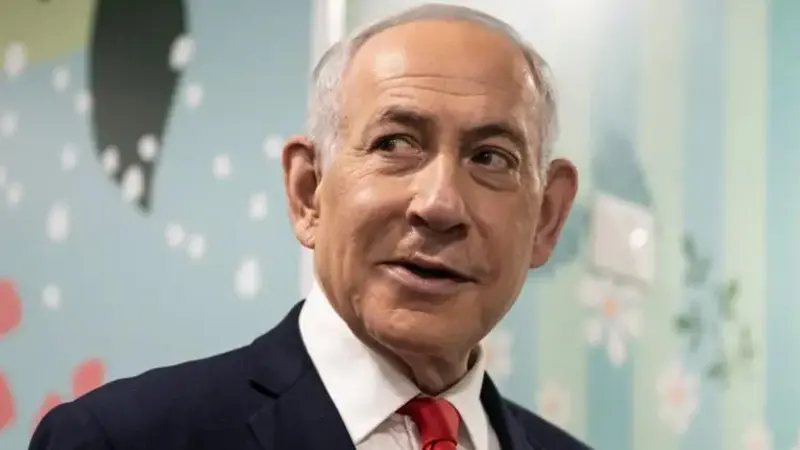
Israeli Prime Minister Benjamin Netanyahu is set to remain in office as caretaker prime minister despite his bloc’s failure to secure a parliamentary majority in the election. Stronger-than-expected support from Jewish voters has prevented the opposition from gaining enough seats to remove him from power. However, neither side has secured the majority needed to form a government independently.
Arab News reported the development on Thursday (October 29), citing Reuters.
According to the report, projections by Israel’s three major television channels, based on nearly 86 percent of the votes counted, indicated that the right-wing, far-right and ultra-Orthodox bloc led by Netanyahu could win 53 of the Knesset’s 120 seats. The opposition bloc led by Gadi Eisenkot was projected to secure 48 seats, while parties representing Israel’s Arab citizens could win a record 19 seats. The figures could change as vote counting continues.
A government needs the support of at least 61 members of the Knesset to secure a parliamentary majority. Neither Netanyahu’s bloc nor the opposition has independently reached that threshold.
Eisenkot’s bloc may need substantial support from Arab parties to form a government. However, many Jewish political leaders in Israel oppose forming a formal coalition with those parties, complicating the opposition’s efforts to take power.
Netanyahu will continue serving as caretaker prime minister while negotiations over forming a new government take place. He could remain in the role until another election next year if political parties fail to reach an agreement. Although caretaker governments face certain constraints, experts say they retain the authority to make important decisions, including on matters related to the war with Iran.
Guy Lurie, a researcher at the Israel Democracy Institute, said a caretaker government has the same legal powers as a regular government. However, it is expected to exercise restraint, and its freedom to make certain decisions may be more limited.
Speaking to supporters of his Likud party late Wednesday, Netanyahu called for the formation of a strong right-wing national government. Highlighting Israel’s military achievements, he also hinted at the possibility of renewed joint military operations with the United States against Iran.
Describing US President Donald Trump as an ally, Netanyahu said the two countries had a historic opportunity to eliminate the Iranian threat permanently. Trump had earlier urged Israeli voters to keep Netanyahu in power so the two leaders could complete their campaign against Iran. Following the election, Trump claimed his endorsement had played a significant role in the outcome.
Opposition leader Eisenkot, meanwhile, warned against Netanyahu’s handling of the caretaker government. Addressing the heads of security agencies and government officials, he said Netanyahu lacked a mandate for a new government and did not have the public’s trust. He urged officials to stand firm against any attempt to use the security apparatus for political purposes.
Political uncertainty following the election has also affected Israel’s financial markets. The shekel weakened by around 1.6 percent against the US dollar, falling to 3.10 shekels per dollar. Major stock market indices in Tel Aviv also dropped by more than 3 percent.
The election signalled a further strengthening of right-wing politics in Israel. During Netanyahu’s prolonged political dominance, centre-left parties have steadily weakened. Nearly all Jewish political parties now oppose the establishment of an independent Palestinian state, despite the idea having been a central component of internationally backed peace initiatives since the 1990s.
The election was Israel’s first national vote since the Hamas-led attack on October 7, 2023, in which around 1,200 people were killed and 251 taken hostage. Israel subsequently became involved in conflicts involving Gaza, Lebanon and Iran. According to Gaza health authorities, Israeli military operations have killed 74,000 Palestinians and devastated extensive areas of the territory. The war has also contributed to Israel’s growing international isolation.
The International Criminal Court has issued an arrest warrant for Netanyahu over alleged war crimes. He has rejected the allegations as unfounded. He is also facing corruption trials in Israel, which he has described as a conspiracy by powerful interests.
Voter turnout reached 77.7 percent, reportedly the highest in more than two decades. Turnout among Israeli citizens of Palestinian descent was also significant. They make up more than one-fifth of Israel’s population, and many are concerned about what they see as the Netanyahu government’s anti-Arab stance.
Supporters celebrated at the headquarters of the Joint List, an alliance of Arab parties, after exit-poll results were announced. Faten Ghattas, a candidate from the alliance, said they rejected occupation and racism and would remain in Israel.
In a previous election, an Arab party had supported the coalition that removed Netanyahu from power. This time, the opposition bloc’s weaker-than-expected performance has made it more difficult for Eisenkot to form a government without the support of the Joint List. Uncertainty over the formation of Israel’s next government therefore continues.
Sources: Arab News and Reuters