Staff Correspondent
Bangladesh’s participation in the 81st session of the United Nations General Assembly, led by Prime Minister Tarique Rahman, was successful, State Minister for Foreign Affairs Humayun Kabir has said.
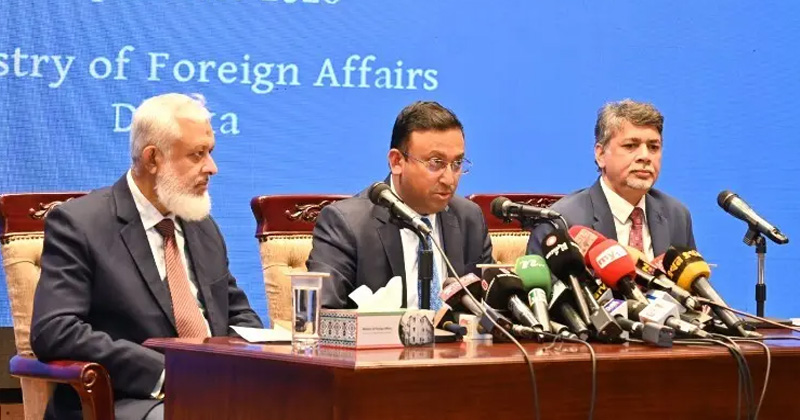
He made the remarks at a press conference held at the Ministry of Foreign Affairs on Monday (September 28). The briefing was organized to highlight various aspects of the Bangladesh delegation’s participation in the UN General Assembly and the prime minister’s visit to New York.
Humayun Kabir said Prime Minister Tarique Rahman arrived in New York on September 21 to attend the UN General Assembly. During his four-day visit, the prime minister took part in 30 international engagements, including an address to the General Debate of the General Assembly, remarks at seven high-level meetings, bilateral meetings with 11 countries and meetings with senior officials of 10 international organizations, including the United Nations.
In his Bengali-language address to the General Debate on September 24, the prime minister highlighted Bangladesh’s democratic transition, the government’s “Recovery, Restoration and Reconstruction,” or “Three-R” strategy for rebuilding the country, the empowerment of women and youth, social protection, education, technology and innovation, and the need for international support for Bangladesh’s graduation from the Least Developed Country (LDC) category.
He also called for the rapid and sustainable repatriation of Rohingyas to Myanmar and urged the United Nations and the international community to take effective steps toward resolving the prolonged crisis. He emphasized dialogue and multilateral diplomacy to address wars, conflicts and humanitarian crises around the world.
The prime minister also reaffirmed Bangladesh’s commitment to peace and security, Palestine, climate justice, development financing, technology transfer, UN peacekeeping and peacebuilding.
On September 23, he participated in a high-level meeting titled “Climate Action and the Just Transition,” convened at the initiative of the UN secretary-general, where he presented Bangladesh’s position on addressing climate change.
On the same day, at a high-level meeting on the Rohingya crisis jointly organized by Bangladesh and The Gambia, he called for a clear roadmap for the rapid and sustainable repatriation of the Rohingyas, an end to violence in Myanmar, adequate humanitarian assistance for Rohingyas sheltered in Bangladesh, and justice and accountability for crimes against humanity.
The prime minister also delivered the opening remarks at a high-level meeting on the risks posed by rising sea levels, organized at the initiative of the president of the UN General Assembly. He also participated in a Bangladesh-Sweden joint meeting on integrating midwifery into primary healthcare and outlined the government’s plans in this regard.
During the visit, Prime Minister Tarique Rahman held bilateral meetings with the presidents of Türkiye and Iran, the vice president of the Maldives, and the prime ministers of Bhutan, Pakistan, Thailand, Croatia and Haiti, as well as the crown prince of Kuwait. The deputy prime ministers and foreign ministers of Saudi Arabia and the United Arab Emirates also paid courtesy calls on him.
He also held meetings with the UN secretary-general, the president of the World Bank Group, the UN High Commissioner for Refugees, the UN High Commissioner for Human Rights, the UN secretary-general’s special envoy for Myanmar, the founder of the International Peace Institute, the chief executive of the Gates Foundation, the CEO of Boeing Global and investors from Wall Street.
Humayun Kabir said that alongside the prime minister’s engagements, he held meetings with the foreign ministers of Brazil and Trinidad and Tobago. State Minister for Foreign Affairs-2, the foreign secretary and the secretary for East-West affairs also participated in various high-level meetings, while other members of the delegation represented Bangladesh at different events.
According to the state minister, Bangladesh’s participation in this year’s General Assembly provided an opportunity to present the new government’s commitments and expectations on the global stage while creating scope for expanding bilateral and multilateral cooperation.
The press conference was also attended by M Farhadul Islam, secretary of the Ministry of Foreign Affairs (Intergovernmental Organizations Division), and Additional Foreign Secretary A.K.M. Shahidul Karim.