Dhaka 3:14 pm, Monday, 9 November 2026

Ensuring Access to Justice Is the State’s Responsibility: Law Minister

Law, Justice and Parliamentary Affairs Minister Md. Asaduzzaman has said that ensuring access to justice is an integral part of protecting human rights. Every individual has inherent, inalienable and universal rights, and it is the responsibility of the state to ensure that citizens can exercise those rights.

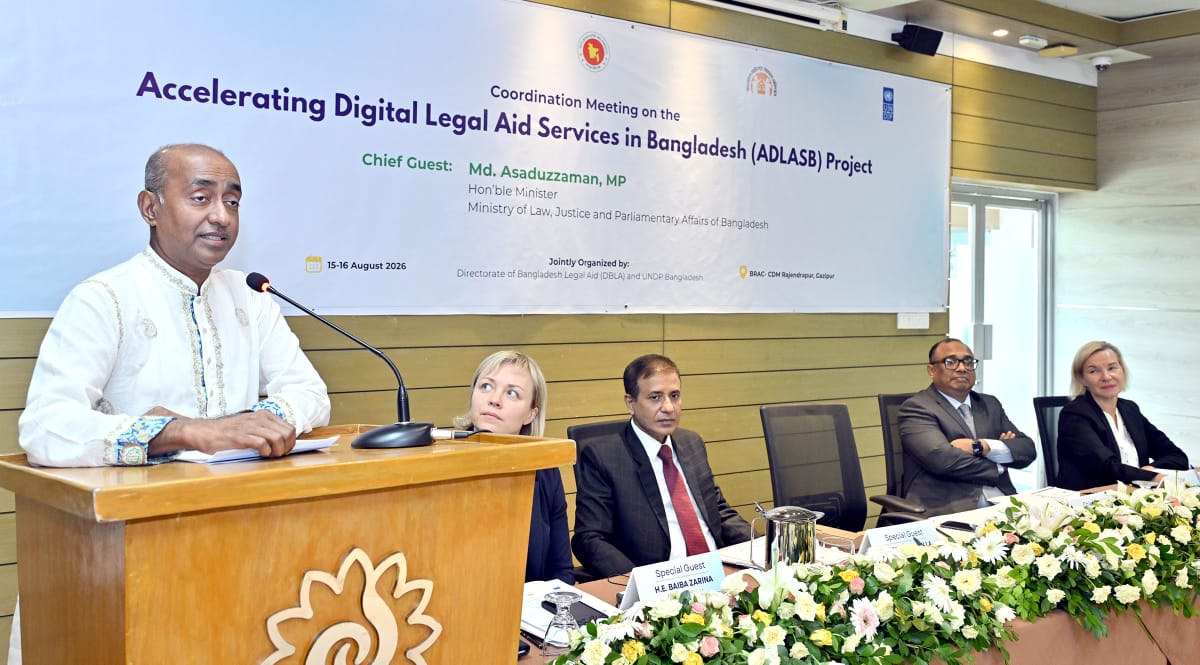
He made the remarks on Saturday morning while inaugurating a two-day coordination meeting of the Accelerating Digital Legal Aid Services in Bangladesh project at BRAC-CDM in Rajendrapur, Gazipur. Judges, legal aid officials and other relevant stakeholders are participating in the meeting.

A key focus of the meeting is ensuring effective access to digital legal aid for disadvantaged and marginalized communities. Discussions are underway to strengthen coordination and improve the effectiveness of 57 Upazila Legal Aid Committees and 413 Union Legal Aid Committees across nine districts—Rajbari, Habiganj, Barguna, Netrakona, Joypurhat, Thakurgaon, Jhenaidah, Khagrachhari and Bogura.

The minister emphasized developing these committees into effective platforms for delivering legal assistance at the grassroots level. This would enable poor people, women, persons with disabilities and other disadvantaged groups to obtain legal advice and assistance more easily, while also creating opportunities for disputes to be resolved through mediation before reaching court when appropriate.

Asaduzzaman said access to justice is not limited to resolving disputes or conducting mediation. Its fundamental objective is to protect, safeguard and ensure the human rights of every citizen. Even a person accused of a serious crime has the right to defend themselves, and the state must ensure that right.

He said judges should not restrict themselves to the literal wording of the law. They must interpret laws by considering the facts of each case, its social context and the broader objective of justice. Judicial officers, he added, must ultimately serve the people.

The minister instructed the Director General of the National Legal Aid Services Organization to take necessary steps to recognize eight outstanding legal aid officers—one from each of the country’s eight divisions—for their exceptional and exemplary contributions to providing legal aid services in their respective workplaces.

He also called for initiatives to recognize 20 judicial officers from across the country based on evaluations of their outstanding and exemplary performance.

According to the minister, such recognition can encourage officials to improve their performance and may also have a positive impact when considering financial incentives, promotions and priority for important postings.

Highlighting the importance of digitalization, he said digital technology can increase public awareness of legal aid services while making application submission, case-progress monitoring and dispute resolution easier. However, he stressed that potential risks associated with the use of artificial intelligence (AI) must also be taken into account.

The meeting also discussed institutionalizing an Online Dispute Resolution (ODR) system in light of the 2026 amendments to the Legal Aid Services Act, 2000, as well as integrating mediation with the digital legal aid system. Presentations were also made on the design, development and implementation of the digital legal aid system and findings from related research.

The law minister said Bangladesh currently has around 4.5 million pending cases. The government aims to significantly reduce the number of cases within the next year. He said the coordinated use of legal aid, mediation, digital technology and judicial proceedings will play an important role in achieving this goal.

The meeting was chaired by Md. Manjurul Hossain, Director General of the National Legal Aid Services Organization. UNDP Bangladesh Senior Rule of Law, Justice and Security Adviser Romana Schwoeger, European Union Chargé d’Affaires in Bangladesh Baiba Zarina and Law and Justice Division Secretary Liaquat Ali Molla also spoke at the event.

On the second day of the meeting, August 16, district and sessions judges will discuss training, activities of legal aid committees, and the preservation and preparation of reports on legal aid-related information. The meeting will also review measures to ensure judicial services and legal assistance for women, persons with disabilities and people living in poverty, while identifying areas for improving digital services.


Ensuring Access to Justice Is the State’s Responsibility: Law Minister

Update Time: 05:47:06 pm, Saturday, 15 August 2026

Law, Justice and Parliamentary Affairs Minister Md. Asaduzzaman has said that ensuring access to justice is an integral part of protecting human rights. Every individual has inherent, inalienable and universal rights, and it is the responsibility of the state to ensure that citizens can exercise those rights.

He made the remarks on Saturday morning while inaugurating a two-day coordination meeting of the Accelerating Digital Legal Aid Services in Bangladesh project at BRAC-CDM in Rajendrapur, Gazipur. Judges, legal aid officials and other relevant stakeholders are participating in the meeting.

A key focus of the meeting is ensuring effective access to digital legal aid for disadvantaged and marginalized communities. Discussions are underway to strengthen coordination and improve the effectiveness of 57 Upazila Legal Aid Committees and 413 Union Legal Aid Committees across nine districts—Rajbari, Habiganj, Barguna, Netrakona, Joypurhat, Thakurgaon, Jhenaidah, Khagrachhari and Bogura.

The minister emphasized developing these committees into effective platforms for delivering legal assistance at the grassroots level. This would enable poor people, women, persons with disabilities and other disadvantaged groups to obtain legal advice and assistance more easily, while also creating opportunities for disputes to be resolved through mediation before reaching court when appropriate.

Asaduzzaman said access to justice is not limited to resolving disputes or conducting mediation. Its fundamental objective is to protect, safeguard and ensure the human rights of every citizen. Even a person accused of a serious crime has the right to defend themselves, and the state must ensure that right.

He said judges should not restrict themselves to the literal wording of the law. They must interpret laws by considering the facts of each case, its social context and the broader objective of justice. Judicial officers, he added, must ultimately serve the people.

The minister instructed the Director General of the National Legal Aid Services Organization to take necessary steps to recognize eight outstanding legal aid officers—one from each of the country’s eight divisions—for their exceptional and exemplary contributions to providing legal aid services in their respective workplaces.

He also called for initiatives to recognize 20 judicial officers from across the country based on evaluations of their outstanding and exemplary performance.

According to the minister, such recognition can encourage officials to improve their performance and may also have a positive impact when considering financial incentives, promotions and priority for important postings.

Highlighting the importance of digitalization, he said digital technology can increase public awareness of legal aid services while making application submission, case-progress monitoring and dispute resolution easier. However, he stressed that potential risks associated with the use of artificial intelligence (AI) must also be taken into account.

The meeting also discussed institutionalizing an Online Dispute Resolution (ODR) system in light of the 2026 amendments to the Legal Aid Services Act, 2000, as well as integrating mediation with the digital legal aid system. Presentations were also made on the design, development and implementation of the digital legal aid system and findings from related research.

The law minister said Bangladesh currently has around 4.5 million pending cases. The government aims to significantly reduce the number of cases within the next year. He said the coordinated use of legal aid, mediation, digital technology and judicial proceedings will play an important role in achieving this goal.

The meeting was chaired by Md. Manjurul Hossain, Director General of the National Legal Aid Services Organization. UNDP Bangladesh Senior Rule of Law, Justice and Security Adviser Romana Schwoeger, European Union Chargé d’Affaires in Bangladesh Baiba Zarina and Law and Justice Division Secretary Liaquat Ali Molla also spoke at the event.

On the second day of the meeting, August 16, district and sessions judges will discuss training, activities of legal aid committees, and the preservation and preparation of reports on legal aid-related information. The meeting will also review measures to ensure judicial services and legal assistance for women, persons with disabilities and people living in poverty, while identifying areas for improving digital services.