Dhaka 3:13 pm, Monday, 9 November 2026

PM Orders Installation of Solar Panels on Key Government Buildings

Prime Minister Tarique Rahman has directed the authorities to install solar panels in key government buildings across the country in phases as part of efforts to address the energy crisis and expand the use of renewable energy.

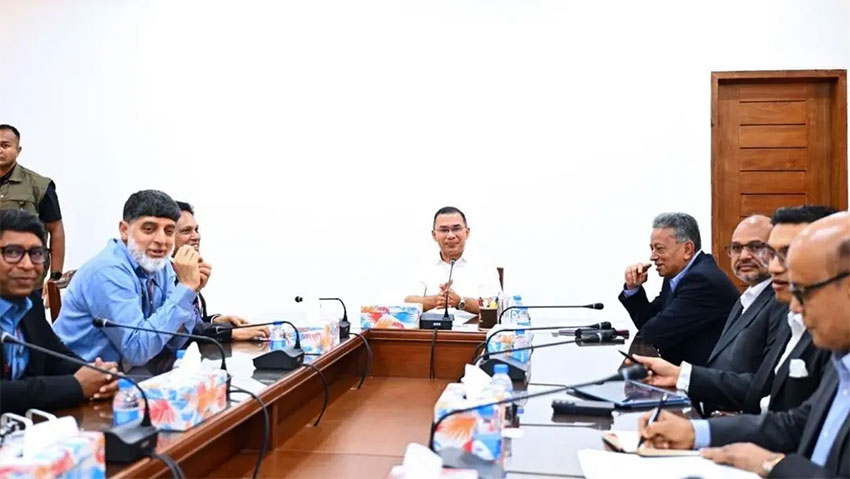
The directive was issued on Monday (August 3) during a meeting on solar power held at the Prime Minister’s Office in the Cabinet Division at the Bangladesh Secretariat.

At the meeting, the Prime Minister announced three key initiatives:

Solar panels will be installed in important government buildings in phases.
Government support will be provided for the import of raw materials used in the production of solar inverters in Bangladesh.
A viable economic model will be developed to make solar power affordable, accessible, and financially beneficial for the general public.

The meeting decided that, in the initial phase, solar panels would be installed at Bangabhaban, the Prime Minister’s Office in Tejgaon, the Jatiya Sangsad (Parliament) Building, the Prime Minister’s Office and the Ministry of Finance buildings at the Bangladesh Secretariat, the Planning Commission Building, and other important government facilities.

The Prime Minister said that introducing solar energy in government buildings would encourage wider public adoption of the technology.

“Once solar power is used in government buildings, people will be more encouraged to adopt the technology in their own homes and institutions,” he said.

During the meeting, PRAN-RFL Group and Walton Group delivered separate presentations on installing solar panels in residential buildings and integrating surplus electricity into the national grid.

According to the presentations, the initiative would help reduce electricity and fuel consumption while creating new employment opportunities. The companies also highlighted that the technology could efficiently power electrical appliances such as air conditioners, fans, elevators, and other equipment.

The meeting also emphasized the need to widely promote the economic and practical benefits of solar energy in order to encourage greater public adoption.

Among those present were Finance and Planning Minister Amir Khasru Mahmud Chowdhury, the Prime Minister’s Adviser on Finance and Planning Rashed Al Mahmud Titumir, State Minister for Local Government Mir Shahe Alam, BIDA Executive Chairman Ashik Chowdhury, Acting NBR Chairman Ahsan Habib, PRAN-RFL Group Chairman Ahsan Khan Chowdhury, AGM (Solar and Renewable Energy Division) Towhidul Ahad, Walton Group Managing Director S. M. Mahbubul Alam, as well as secretaries and senior officials from various ministries.


PM Orders Installation of Solar Panels on Key Government Buildings

Update Time: 05:33:17 pm, Monday, 3 August 2026

Prime Minister Tarique Rahman has directed the authorities to install solar panels in key government buildings across the country in phases as part of efforts to address the energy crisis and expand the use of renewable energy.

The directive was issued on Monday (August 3) during a meeting on solar power held at the Prime Minister’s Office in the Cabinet Division at the Bangladesh Secretariat.

At the meeting, the Prime Minister announced three key initiatives:

Solar panels will be installed in important government buildings in phases.
Government support will be provided for the import of raw materials used in the production of solar inverters in Bangladesh.
A viable economic model will be developed to make solar power affordable, accessible, and financially beneficial for the general public.

The meeting decided that, in the initial phase, solar panels would be installed at Bangabhaban, the Prime Minister’s Office in Tejgaon, the Jatiya Sangsad (Parliament) Building, the Prime Minister’s Office and the Ministry of Finance buildings at the Bangladesh Secretariat, the Planning Commission Building, and other important government facilities.

The Prime Minister said that introducing solar energy in government buildings would encourage wider public adoption of the technology.

“Once solar power is used in government buildings, people will be more encouraged to adopt the technology in their own homes and institutions,” he said.

During the meeting, PRAN-RFL Group and Walton Group delivered separate presentations on installing solar panels in residential buildings and integrating surplus electricity into the national grid.

According to the presentations, the initiative would help reduce electricity and fuel consumption while creating new employment opportunities. The companies also highlighted that the technology could efficiently power electrical appliances such as air conditioners, fans, elevators, and other equipment.

The meeting also emphasized the need to widely promote the economic and practical benefits of solar energy in order to encourage greater public adoption.

Among those present were Finance and Planning Minister Amir Khasru Mahmud Chowdhury, the Prime Minister’s Adviser on Finance and Planning Rashed Al Mahmud Titumir, State Minister for Local Government Mir Shahe Alam, BIDA Executive Chairman Ashik Chowdhury, Acting NBR Chairman Ahsan Habib, PRAN-RFL Group Chairman Ahsan Khan Chowdhury, AGM (Solar and Renewable Energy Division) Towhidul Ahad, Walton Group Managing Director S. M. Mahbubul Alam, as well as secretaries and senior officials from various ministries.