Staff Reporter
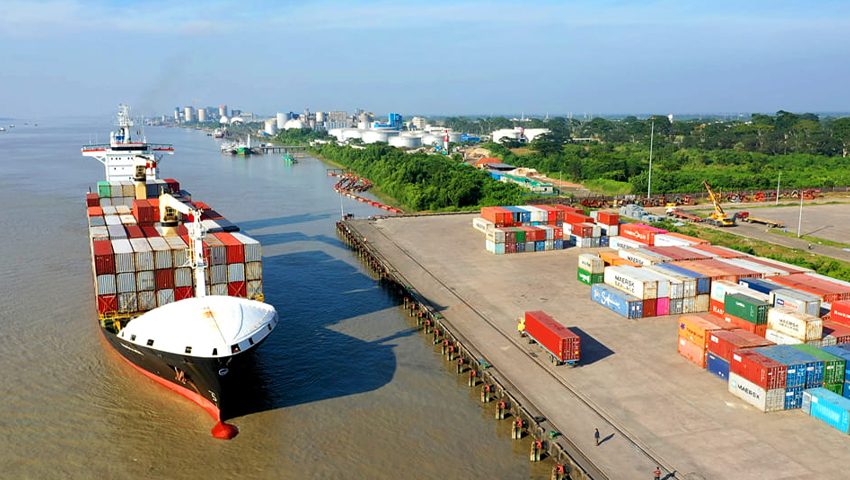
Mongla Port, one of the key centres of the country’s import-export trade and Bangladesh’s second-largest seaport, is on the threshold of a major transformation. Prime Minister Tarique Rahman visited the Sundarbans and Mongla Port on October 22. It was his first visit to Khulna since assuming office as prime minister. Plans to establish an economic corridor, a major loan agreement with China’s Exim Bank, and the prime minister’s on-site inspection have generated renewed optimism across the southwestern region.
If the proposed projects are implemented swiftly, Mongla Port could emerge as a major regional trade hub and a preferred first port of call. With integrated sea, road, rail and air connectivity, the port has the potential to become an international trade centre.
According to the Mongla Port Authority, a loan agreement worth US$335.78 million, equivalent to approximately Tk 4,000 crore, was signed with China’s Exim Bank on October 10. The investment aims to significantly increase container-handling capacity and transform the port through digitalisation. Plans are also underway to improve navigability through regular dredging of the Mongla Port channel. This would enable larger cargo vessels with deeper drafts to berth directly at the jetties, a facility currently available only on a limited scale.
Securing recognition as a first port of call is highly significant and commercially beneficial in international maritime trade. If foreign vessels can berth directly at Mongla, reducing their dependence on Chattogram Port, cargo handling and clearance times could be significantly reduced. The competitiveness of Bangladesh’s ready-made garments, jute, leather and frozen shrimp exports could also improve in global markets.
The development plan extends beyond port modernisation to include a comprehensive transport network. Upgrading the Khulna-Mongla road to four lanes and advancing construction of the Khulna-Bhanga connecting road are among the key priorities. The introduction of freight wagon and container trains, alongside the proposed launch of Khan Jahan Ali Airport, is also gaining importance. The proposed economic zone under the Bangladesh Economic Zones Authority (BEZA) could attract major domestic and foreign industrial groups to establish factories around the port.
On October 22, Prime Minister Tarique Rahman inspected Jetty No. 9 at Mongla Port and the proposed BEZA economic zone. His visit has generated renewed enthusiasm among local businesspeople and port officials. According to business leaders, resolving long-standing infrastructure problems could transform the economic landscape of the southwestern region. Mongla Port could become one of the country’s major economic drivers.
The long-awaited Khan Jahan Ali Airport has also emerged as an important priority, as improved air connectivity would facilitate the movement of international businesspeople, foreign shipping representatives and major investors. Once operational, the airport could encourage more domestic and foreign investors to visit Mongla Port and the proposed BEZA economic zone. Addressing these infrastructure challenges could usher in a new chapter for the national economy through a more integrated transport network centred on Mongla Port.
Mohammad Salah Uddin Kabir, deputy director of the Mongla Port Authority, said the prime minister had provided necessary directives on various aspects of the port’s overall development, including capacity expansion, infrastructure improvement and ensuring adequate navigability. The prime minister subsequently visited the proposed BEZA economic zone. The port authority expects that dredging the channel will improve navigability and allow vessels with deeper drafts to berth at the port.
The prime minister’s visit could help Mongla Port play a more significant role in trade, commerce and industrialisation across Khulna, Bagerhat and the wider southwestern region. Local people are expected to benefit if long-standing unresolved issues and infrastructure bottlenecks in the port area are addressed promptly.
Mohammad Julfikar Ali, general secretary of the Mongla Port Berth and Ship Operators Association, said Mongla Port had enormous potential. The prime minister’s visit would accelerate efforts to realise that potential, he added. The development of a new economic zone and an LNG terminal could expand business and trade activities, positively affecting the economy of the southwestern region.
Sheikh Shahed Ali Robi, president of the Bagerhat Chamber of Commerce and Industry, said expanding Mongla Port’s capacity was essential to easing pressure on Chattogram Port. Alongside dredging to improve the navigability of the port channel, he stressed the need to modernise Mongla Customs House and the customs administration. He expressed hope that the prime minister’s visit would help advance these initiatives.
Dr Sheikh Faridul Islam, state minister for forests, environment and climate change, said the prime minister’s visit would accelerate investment in the region. Development projects could also create alternative employment opportunities for coastal residents who have lost their livelihoods because of climate change. He said successful implementation of these initiatives could bring significant changes to the economy, infrastructure and living standards of people across the southwestern region.