Dhaka 2:55 pm, Monday, 9 November 2026

Saltwater, Survival and Women’s Livelihoods: Millions at Health Risk Along the Sundarbans Coast

The coastal belt adjoining the Sundarbans in southwestern Bangladesh is no longer merely a region bearing the impacts of climate change—it has become a grim portrait of women’s silent struggle for survival.

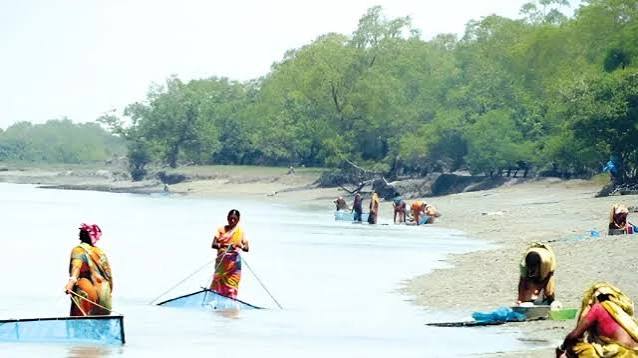
Across vast areas of Bagerhat, Khulna and Satkhira, thousands of women enter saline rivers every day to support their families. Some drag nets to catch shrimp fry, others work in shrimp farms, while many walk miles to collect drinking water. Driven by poverty, this daily struggle is pushing them toward serious health risks.

Women spend hours standing in saline river water, pulling nets and battling the tides to earn a living. Yet the effects of prolonged exposure to salinity on their health and reproductive well-being are often overshadowed by the immediate demands of survival.

In Pata Khali village of Padmapukur Union in Shyamnagar, Satkhira, 50-year-old Amirun Bibi lives in a small hut beside the Kapatakkha River. The hut is her “palace.” She has lived there with her only daughter, Babita, since Cyclone Aila struck in 2009. Her home has been damaged repeatedly by disasters and repaired again and again. After her husband left 20 years ago, the river became her main source of income.

“I catch shrimp fry by dragging a net in the river and sell them at the market. Some days I earn Tk 200-300, and some days I earn nothing. One hundred shrimp fry sell for only Tk 40,” Amirun said.

Asked whether she had received any government assistance, tears welled up in her eyes.

“I have lived beside the river for so many years, but no one has given me even a single taka. I did not even receive a card for subsidised rice. The government provides houses, but I did not get one. The river has a shore, but I have none,” she said.

Amirun is not alone. Around 50 families living along the riverbank in Padmapukur Union face similar hardships. Monjila Khatun lives with her four sons in a house provided by an NGO. Her husband is elderly and physically unable to work. She now bears the responsibility of supporting the family. By catching shrimp fry in the river, she earns around Tk 300-400 a day.

The same picture can be seen in the coastal areas of Gabura Union in Shyamnagar. Women work in rivers and shrimp farms, while men often move from one job to another, working in brick kilns or as day labourers. Many families live in small huts along riverbanks despite the constant threat of disasters.

The silent danger of salinity

One of the biggest challenges facing the coastal region is the shortage of safe drinking water. Rising salinity, tidal water, shrimp farming and frequent natural disasters have severely reduced access to freshwater in many areas.

Women are often forced to walk long distances to collect drinking water. In some places, they wait for hours for access to freshwater.

Experts say prolonged consumption of highly saline water can increase health risks, including high blood pressure. Excessive salt intake can be particularly dangerous for pregnant women, increasing the risk of hypertension, pregnancy-related complications and convulsions.

Long-term exposure to saline water while working in rivers and shrimp farms may also have adverse effects on women’s skin and overall health, while concerns remain over its potential impact on reproductive health. As a result, the women who enter the rivers to protect their livelihoods are also among those most exposed to the health risks associated with salinity.

More work, lower wages

Climate change has reduced agricultural and other employment opportunities in coastal areas, forcing some men to migrate elsewhere in search of work. During government-imposed bans on entering the Sundarbans or fishing, many forest-dependent families lose their main source of income. The responsibility of keeping households running then falls heavily on women.

Sabina Khatun of Munshiganj in Shyamnagar said her husband cannot find work when the forest is closed.

“When the forest is closed, my husband has no work. But household expenses and loan instalments do not stop. So I am forced to work in shrimp farms, enduring the heat and getting soaked in water,” she said.

The inequality does not end there. Local women workers say that while a male worker receives Tk 400-500 a day for similar work, women often receive only Tk 250-300. Because women can be hired at lower wages, shrimp farm owners are sometimes more interested in employing them.

Fishing bans bring silent hunger

The government imposes seasonal restrictions on entering the Sundarbans and fishing to protect biodiversity and breeding grounds. During forest closures, fishing bans and natural disasters, poor forest-dependent families face the greatest hardship.

Nepal Sana, a forest-dependent worker, said, “I have been catching fish and crabs in the Sundarbans since childhood. I have no other skills. When the forest is closed, there is no work. We are forced to send women from our families to work as day labourers.”

According to government data, around 49,000 fishermen are registered in Satkhira, including 12,889 who fish in the deep sea. Shyamnagar has 7,355 registered fishermen.

During fishing bans, a portion of registered fishermen receive Vulnerable Group Feeding (VGF) assistance. However, local fishermen and trawler owners claim that the actual number of fishermen is much higher than the government records, leaving many unregistered fishing families outside the social safety net.

Broken embankments, saline water and disappearing agriculture

Agriculture in the coastal region is also under severe pressure from salinity. Cyclones Sidr, Aila, Fani and Bulbul, among others, have repeatedly damaged embankments. In some areas, embankments have collapsed, allowing saline water to enter. Elsewhere, embankments have been cut to bring saline water into shrimp farms.

Land that once produced rice has increasingly been converted into shrimp enclosures. As agricultural activities decline, employment opportunities also shrink. Women are increasingly filling the gap by working as day labourers, in shrimp farms and in physically demanding river-based jobs such as collecting shrimp fry.

Climate change, rising sea levels, stronger cyclones, tidal surges and expanding salinity are combining to make life increasingly uncertain along the coast. Women and adolescent girls are carrying a disproportionate share of the burden.

No home, no land—yet life continues beside the river

Mohammad Amzad Hossain, chairman of Padmapukur Union in Shyamnagar, said around 50 families live along the riverbank. Many depend on river fishing for their livelihoods. Efforts are made to provide VGD, VGF and other government assistance to vulnerable families, but lack of land ownership remains a major obstacle to housing support.

G.M. Masudul Alam, chairman of Gabura Union, said lists of vulnerable riverbank families requiring housing had been sent to the upazila administration, but many families have yet to receive houses.

Shyamnagar Upazila Nirbahi Officer Roni Khatun said the administration is working to improve the living conditions of coastal residents. She said government housing generally requires applicants to own land, while initiatives are also being taken to identify landless families and provide land in accordance with government policy. Other social safety-net benefits, including allowances for elderly and widowed people, are also being provided, she said.

Where is the solution?

Experts say relief and VGF support alone cannot solve the problems facing coastal communities. Long-term climate adaptation plans are essential.

They recommend permanent access to safe drinking water in vulnerable areas, construction and excavation of large reservoirs and ponds, rainwater harvesting, stronger embankments and sluice gates, salinity control, expansion of salt-tolerant crops and creation of alternative employment opportunities.

Safe employment with fair wages is particularly important for women. Regular health check-ups, reproductive healthcare and awareness programmes should also be introduced for women who spend long periods working in saline water in rivers and shrimp farms.

Satkhira Climate Council convener Professor Ashique Elahi said climate change and the intrusion of saline water have reduced cultivable land and employment opportunities in coastal areas. When men leave in search of work elsewhere, women become the social and economic shield of their families.

Coastal women demand climate justice

A fundamental question is increasingly being raised by coastal communities: Why should women who did little to cause climate change suffer the most from its consequences?

For women like Amirun Bibi, climate change is not an issue discussed at international conferences. It means a destroyed home, saline water, lost farmland, dangerous work in rivers, unequal wages, uncertain income and daily anxiety over their children’s future.

When a woman pulls a net through a river in the Sundarbans, she is not merely catching a few shrimp fry. She is pulling out the last hope of survival for her family.

But if the price of that hope is her own health, safety and future, a question remains for the state and society: How much longer must the women of the coast wait to be protected?

Ensuring safe drinking water, secure housing, fair wages, healthcare and alternative livelihoods is no longer an optional component of development planning. It is a basic right of survival for coastal women.

Without timely and effective action, the silent crisis unfolding along the Sundarbans coast could one day turn into an even greater humanitarian disaster.


Saltwater, Survival and Women’s Livelihoods: Millions at Health Risk Along the Sundarbans Coast

Update Time: 10:35:56 pm, Monday, 14 September 2026

The coastal belt adjoining the Sundarbans in southwestern Bangladesh is no longer merely a region bearing the impacts of climate change—it has become a grim portrait of women’s silent struggle for survival.

Across vast areas of Bagerhat, Khulna and Satkhira, thousands of women enter saline rivers every day to support their families. Some drag nets to catch shrimp fry, others work in shrimp farms, while many walk miles to collect drinking water. Driven by poverty, this daily struggle is pushing them toward serious health risks.

Women spend hours standing in saline river water, pulling nets and battling the tides to earn a living. Yet the effects of prolonged exposure to salinity on their health and reproductive well-being are often overshadowed by the immediate demands of survival.

In Pata Khali village of Padmapukur Union in Shyamnagar, Satkhira, 50-year-old Amirun Bibi lives in a small hut beside the Kapatakkha River. The hut is her “palace.” She has lived there with her only daughter, Babita, since Cyclone Aila struck in 2009. Her home has been damaged repeatedly by disasters and repaired again and again. After her husband left 20 years ago, the river became her main source of income.

“I catch shrimp fry by dragging a net in the river and sell them at the market. Some days I earn Tk 200-300, and some days I earn nothing. One hundred shrimp fry sell for only Tk 40,” Amirun said.

Asked whether she had received any government assistance, tears welled up in her eyes.

“I have lived beside the river for so many years, but no one has given me even a single taka. I did not even receive a card for subsidised rice. The government provides houses, but I did not get one. The river has a shore, but I have none,” she said.

Amirun is not alone. Around 50 families living along the riverbank in Padmapukur Union face similar hardships. Monjila Khatun lives with her four sons in a house provided by an NGO. Her husband is elderly and physically unable to work. She now bears the responsibility of supporting the family. By catching shrimp fry in the river, she earns around Tk 300-400 a day.

The same picture can be seen in the coastal areas of Gabura Union in Shyamnagar. Women work in rivers and shrimp farms, while men often move from one job to another, working in brick kilns or as day labourers. Many families live in small huts along riverbanks despite the constant threat of disasters.

The silent danger of salinity

One of the biggest challenges facing the coastal region is the shortage of safe drinking water. Rising salinity, tidal water, shrimp farming and frequent natural disasters have severely reduced access to freshwater in many areas.

Women are often forced to walk long distances to collect drinking water. In some places, they wait for hours for access to freshwater.

Experts say prolonged consumption of highly saline water can increase health risks, including high blood pressure. Excessive salt intake can be particularly dangerous for pregnant women, increasing the risk of hypertension, pregnancy-related complications and convulsions.

Long-term exposure to saline water while working in rivers and shrimp farms may also have adverse effects on women’s skin and overall health, while concerns remain over its potential impact on reproductive health. As a result, the women who enter the rivers to protect their livelihoods are also among those most exposed to the health risks associated with salinity.

More work, lower wages

Climate change has reduced agricultural and other employment opportunities in coastal areas, forcing some men to migrate elsewhere in search of work. During government-imposed bans on entering the Sundarbans or fishing, many forest-dependent families lose their main source of income. The responsibility of keeping households running then falls heavily on women.

Sabina Khatun of Munshiganj in Shyamnagar said her husband cannot find work when the forest is closed.

“When the forest is closed, my husband has no work. But household expenses and loan instalments do not stop. So I am forced to work in shrimp farms, enduring the heat and getting soaked in water,” she said.

The inequality does not end there. Local women workers say that while a male worker receives Tk 400-500 a day for similar work, women often receive only Tk 250-300. Because women can be hired at lower wages, shrimp farm owners are sometimes more interested in employing them.

Fishing bans bring silent hunger

The government imposes seasonal restrictions on entering the Sundarbans and fishing to protect biodiversity and breeding grounds. During forest closures, fishing bans and natural disasters, poor forest-dependent families face the greatest hardship.

Nepal Sana, a forest-dependent worker, said, “I have been catching fish and crabs in the Sundarbans since childhood. I have no other skills. When the forest is closed, there is no work. We are forced to send women from our families to work as day labourers.”

According to government data, around 49,000 fishermen are registered in Satkhira, including 12,889 who fish in the deep sea. Shyamnagar has 7,355 registered fishermen.

During fishing bans, a portion of registered fishermen receive Vulnerable Group Feeding (VGF) assistance. However, local fishermen and trawler owners claim that the actual number of fishermen is much higher than the government records, leaving many unregistered fishing families outside the social safety net.

Broken embankments, saline water and disappearing agriculture

Agriculture in the coastal region is also under severe pressure from salinity. Cyclones Sidr, Aila, Fani and Bulbul, among others, have repeatedly damaged embankments. In some areas, embankments have collapsed, allowing saline water to enter. Elsewhere, embankments have been cut to bring saline water into shrimp farms.

Land that once produced rice has increasingly been converted into shrimp enclosures. As agricultural activities decline, employment opportunities also shrink. Women are increasingly filling the gap by working as day labourers, in shrimp farms and in physically demanding river-based jobs such as collecting shrimp fry.

Climate change, rising sea levels, stronger cyclones, tidal surges and expanding salinity are combining to make life increasingly uncertain along the coast. Women and adolescent girls are carrying a disproportionate share of the burden.

No home, no land—yet life continues beside the river

Mohammad Amzad Hossain, chairman of Padmapukur Union in Shyamnagar, said around 50 families live along the riverbank. Many depend on river fishing for their livelihoods. Efforts are made to provide VGD, VGF and other government assistance to vulnerable families, but lack of land ownership remains a major obstacle to housing support.

G.M. Masudul Alam, chairman of Gabura Union, said lists of vulnerable riverbank families requiring housing had been sent to the upazila administration, but many families have yet to receive houses.

Shyamnagar Upazila Nirbahi Officer Roni Khatun said the administration is working to improve the living conditions of coastal residents. She said government housing generally requires applicants to own land, while initiatives are also being taken to identify landless families and provide land in accordance with government policy. Other social safety-net benefits, including allowances for elderly and widowed people, are also being provided, she said.

Where is the solution?

Experts say relief and VGF support alone cannot solve the problems facing coastal communities. Long-term climate adaptation plans are essential.

They recommend permanent access to safe drinking water in vulnerable areas, construction and excavation of large reservoirs and ponds, rainwater harvesting, stronger embankments and sluice gates, salinity control, expansion of salt-tolerant crops and creation of alternative employment opportunities.

Safe employment with fair wages is particularly important for women. Regular health check-ups, reproductive healthcare and awareness programmes should also be introduced for women who spend long periods working in saline water in rivers and shrimp farms.

Satkhira Climate Council convener Professor Ashique Elahi said climate change and the intrusion of saline water have reduced cultivable land and employment opportunities in coastal areas. When men leave in search of work elsewhere, women become the social and economic shield of their families.

Coastal women demand climate justice

A fundamental question is increasingly being raised by coastal communities: Why should women who did little to cause climate change suffer the most from its consequences?

For women like Amirun Bibi, climate change is not an issue discussed at international conferences. It means a destroyed home, saline water, lost farmland, dangerous work in rivers, unequal wages, uncertain income and daily anxiety over their children’s future.

When a woman pulls a net through a river in the Sundarbans, she is not merely catching a few shrimp fry. She is pulling out the last hope of survival for her family.

But if the price of that hope is her own health, safety and future, a question remains for the state and society: How much longer must the women of the coast wait to be protected?

Ensuring safe drinking water, secure housing, fair wages, healthcare and alternative livelihoods is no longer an optional component of development planning. It is a basic right of survival for coastal women.

Without timely and effective action, the silent crisis unfolding along the Sundarbans coast could one day turn into an even greater humanitarian disaster.