Staff Correspondent
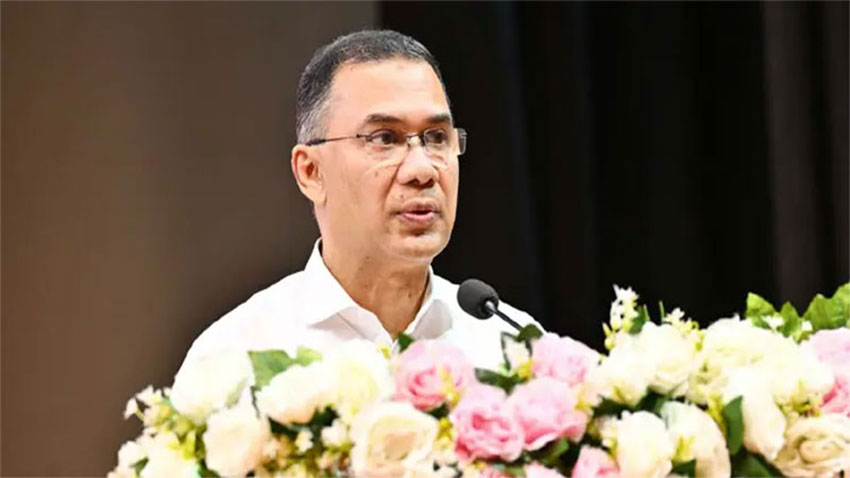
Prime Minister Tarique Rahman has called on all citizens to identify themselves as Bangladeshis, rather than viewing society through the lens of majority or minority status. He urged everyone to remain united so that political affiliation, opinion, religion, ethnicity or any other identity does not become a source of division or discrimination in the state and society.
He made the remarks on Thursday (September 3) morning at a greetings and honorarium distribution ceremony held at the Osmani Memorial Auditorium in the capital on the occasion of Janmashtami. The event brought together prominent members of the Hindu community, while honorariums were distributed among priests and temple attendants.
According to Hindu religious scriptures, Lord Krishna was born on the eighth day of the waning moon. Hindu tradition holds that Krishna, regarded as an incarnation of the deity, was born in Mathura around 5,500 years ago when the region was ruled by the cruel and tyrannical King Kansa. Following Krishna’s appearance, Kansa was defeated. Hindus believe that combating evil and upholding righteousness were among Krishna’s principal missions.
The prime minister said that Bangladesh had also experienced the rule of a cruel figure like Kansa who had taken away the rights of democracy-loving people and imposed himself on the nation. After more than a decade and a half, people from all political, religious and social backgrounds brought about the fall of those “Kansa-like” fascists at the cost of thousands of lives. Democracy has now begun its journey again in Bangladesh, he said.
He said the next task is to rebuild the country by improving its fragile economy, divided administration and deteriorating law-and-order situation.
Tarique Rahman described the coexistence of people from different religions and schools of thought as the beauty of a diverse society. He said those who are considered a “minority” or “majority” in Bangladesh may find themselves regarded as a “minority” when travelling to Europe or America. Therefore, in today’s global village, such labels should not be considered the defining identity of citizens.
Referring to the political philosophy of “Bangladeshi nationalism” championed by the country’s independence proclaimer, the prime minister said everyone must remain united so that political views, religion, ethnicity or identity do not create divisions and discrimination. He said the proud identity of every citizen should be: “We are Bangladeshis.”
He noted that people in Bangladesh have historically lived together regardless of political views, religion or ethnicity, maintaining mutual respect, harmony and communal solidarity while observing their respective religions and cultures.
However, he warned that at different times, people with “Kansa-like” characteristics have attempted to fuel divisions and conflicts in society and the state. Everyone must remain vigilant so that anti-social forces cannot rise again and no one can undermine the existing atmosphere of harmony, he said. Maintaining mutual goodwill and communal harmony is a responsibility of all citizens, he added.
On the occasion of Janmashtami, the prime minister called on everyone to further strengthen religious harmony, tolerance, mutual respect and the bonds of goodwill and solidarity.
He also said some people were spreading rumours in various ways to destabilize the country. Referring to attempts to provoke people through social media, he urged everyone to remain alert so that communal incitement or hatred could not create instability in society.
The prime minister said the government is committed to ensuring the security of every citizen. Political and economic empowerment of citizens is essential to building a prosperous and self-reliant Bangladesh while strengthening the country’s sovereignty, he said.
To achieve that goal, the government is implementing various initiatives, including the Family Card, Farmer Card and Sports Card, as well as honorarium allowances for religious leaders of all faiths, he said.
Tarique Rahman said the government wants to establish a welfare-oriented state where the state will provide necessary support to citizens regardless of their political views, religion or ethnicity, according to its capacity and resources. At the same time, citizens will fulfil their responsibilities toward the state.
He said the desired welfare state would emerge through mutual “responsibility, trust and dialogue” among the “state-government and citizens.” The government is determined to ensure that no one is left behind, he said, emphasizing the need for collective efforts and cooperation.
“This country belongs to you, me and all of us,” the prime minister said, stressing that all citizens have equal rights in the country.
He also described the right to live according to one’s religious beliefs and culture as a fundamental constitutional right of every citizen. The prime minister said, Religion is for everyone, the state belongs to all. Everyone has the right to security, regardless of their religion.”
Referring to the upcoming Durga Puja following Janmashtami, he wished that everyone would be able to celebrate all religious festivals peacefully, comfortably and safely.
He concluded his remarks by extending greetings on Janmashtami and advance wishes for the upcoming Durga Puja.