Staff Correspondent
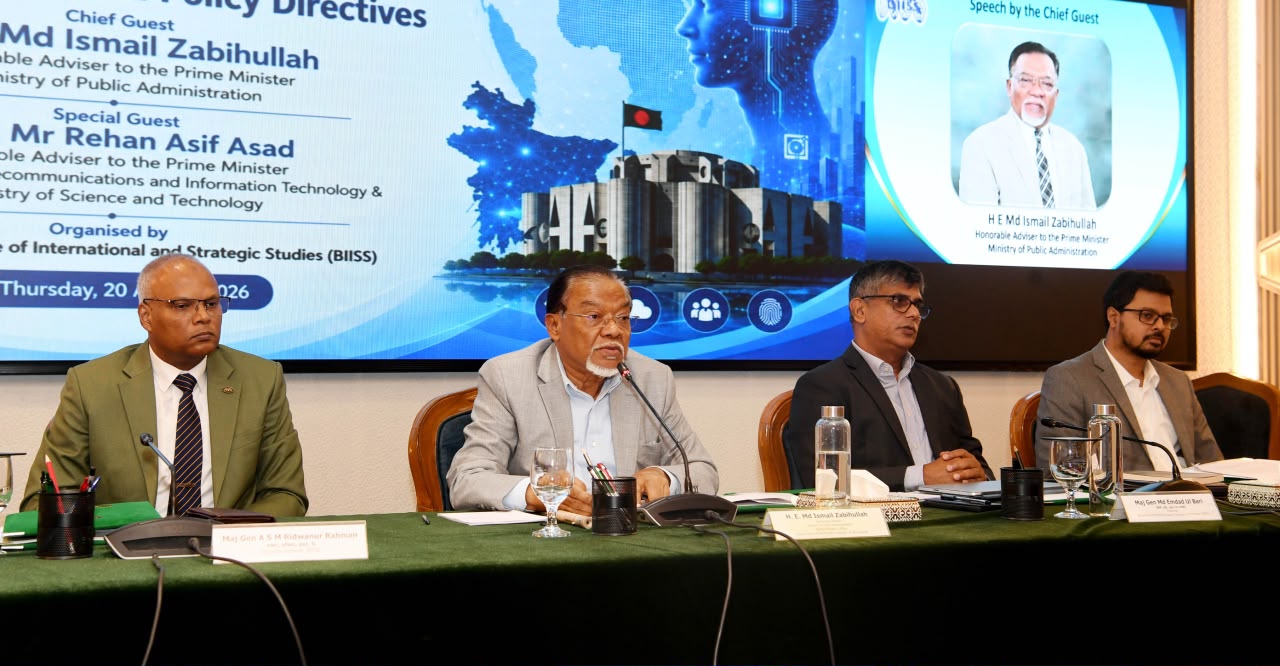
BNP National Standing Committee member and Prime Minister’s Adviser on Public Administration, holding ministerial rank, Md. Ismail Jabiullah has called for ensuring efficiency, transparency and citizen-friendly services through the use of artificial intelligence (AI) in public administration. He also stressed the need to protect data privacy, obtain proper consent for the use of personal information and exercise caution in deploying AI.
He made the remarks on Thursday while speaking as the chief guest at a seminar titled “AI and Governance: Global Technology Architecture, National Digital Public Infrastructure and Policy Directives” at the auditorium of the Bangladesh Institute of International and Strategic Studies (BIISS) in Dhaka.
The adviser said AI is no longer merely a technological issue; it has become an important component of national capacity, good governance, the economy, security and geopolitics. He said government services should be made faster, easier, more transparent and citizen-friendly by gradually adopting AI while ensuring public consent, awareness and security.
Md. Ismail Jabiullah said Bangladesh has a large population along with talented and skilled people and enormous potential. However, he noted that talent alone cannot create national capacity. Talent must be transformed into technology, technology into institutional capacity, and institutional capacity into national strength. For this, he stressed the need for a strong and integrated AI ecosystem.
Referring to Israel’s experience, he said more than 2,150 AI-based companies have been established there. Bangladesh can learn from this experience, as even a small country can create a technological impact far beyond its size by coordinating talent, research, capital, universities and entrepreneurial initiatives.
Highlighting the importance of AI in public administration, the adviser said the public administration sector should be the first major area of Bangladesh’s AI transformation. He said it would be possible to establish a system where officials would no longer need to spend hours searching through files or contacting other offices for information.
Based on authorized government databases, an AI assistant could provide relevant information along with applicable rules, circulars, previous decisions and sources, he said.
According to him, such a system could save officials’ time, accelerate decision-making and improve the efficiency of government services. Referring to training initiatives for government employees in the United Kingdom, he said Bangladesh should also take the necessary steps without further delay.
He said AI could play an important role in various areas of public administration, including government expenditure, procurement, recruitment, healthcare, taxation, social protection and file management. If the Planning Commission and the Finance Division use AI in project formulation, assessment of expenditure justification and project monitoring, both time and public funds could be saved.
He also said AI could be used to make various citizen and district-level services, including healthcare, passport issuance and driving licences, faster, easier and more automated.
Emphasizing data privacy and cybersecurity, he said clear policies are needed to determine what information can be used or shared for AI and at what level. Alongside public awareness to combat fraud risks, he stressed the need for strong cybersecurity measures, data classification and a clear legal framework.
Referring to the rapidly expanding impact of AI on national security and strategic affairs, the adviser said AI is increasingly being used in modern military systems for intelligence gathering, surveillance, automated operations, target identification and precision missions. He said countries that control advanced computing capabilities, data and algorithms will have greater influence over the strategic balance in the future.
Citing the India-China border as an example, he said there is a growing trend of using robots and automated technologies for surveillance instead of soldiers in various areas. AI, robotics and optical technologies have become important strategic components of modern state systems, he added.
Highlighting both the opportunities and risks associated with AI, Md. Ismail Jabiullah said, “A matchstick can be used to cook food, but it can also burn down a house—AI is just like that.” He said AI can improve the quality of government services, but it can also create new risks and inequalities. Therefore, he stressed that technology must be used safely, responsibly and for public welfare.
He said AI may bring changes to employment. However, inefficiency should not be preserved merely to protect jobs. “Our goal should be an AI-assisted government, not a government without people,” he said, emphasizing the need to find an acceptable and public-oriented balance between technology and employment.
He further said the advancement of AI cannot be stopped. However, its risks can be controlled and its benefits ensured for public welfare through laws, policies, security measures and public awareness. Therefore, AI should be adopted gradually while ensuring public consent and awareness.
BIISS Director General Major General ASM Ridwanur Rahman, AWC, AFWC, PSC, G, delivered the welcome address. Dr. Syed Muntasir Mamun, Director General of the International Trade, Investment and Technology and ICT Division of the Ministry of Foreign Affairs of the Government of Bangladesh, presented the keynote paper. Ashfaq Zaman, Chief Strategist of the Dhaka Forum Initiative, presented another paper.
Following the presentations, an open discussion was held. Participants exchanged views on the opportunities and challenges of adopting AI, the role of local needs in formulating AI-related policies and standards, and the growing role of AI in cyber operations and modern warfare amid the changing security landscape.
The seminar was chaired by Bangladesh Telecommunication Regulatory Commission Chairman Major General Md. Emdad Ul Bari, OSP, ndc, psc, TE (Retd.). Senior officials from various ministries and government agencies, representatives of regulatory bodies, development partners, technology and financial sector representatives, academics, researchers, policymakers and students attended the seminar.